

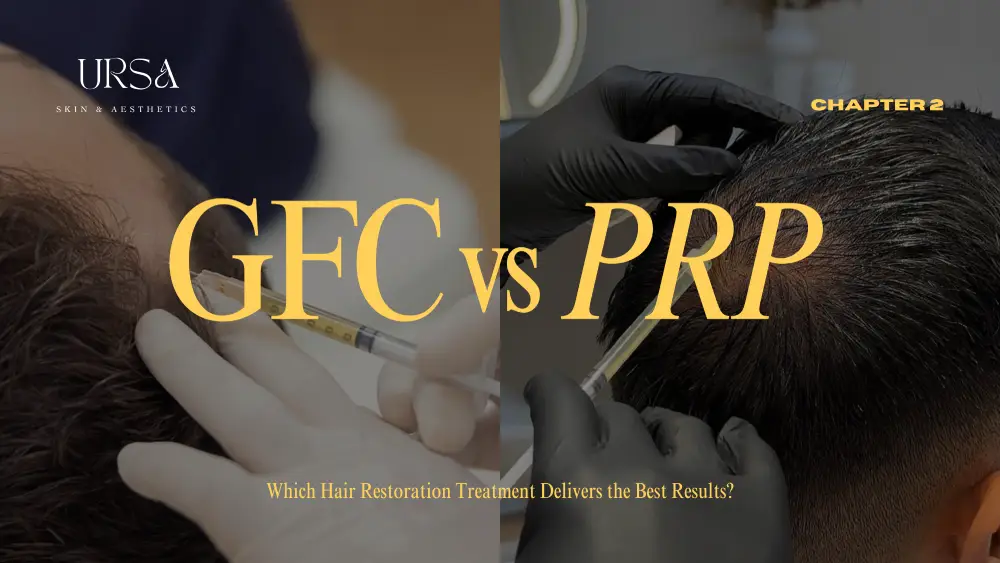
- GFC (Growth Factor Concentrate) is a more advanced evolution of PRP that delivers higher concentrations of specific hair-stimulating growth factors.
- Both treatments are effective for androgenetic alopecia and telogen effluvium, stimulating follicle activity and reducing hair fall.
- GFC produces comparable or modestly superior results to standard PRP due to its more selective and potent growth factor concentration.
- A standard initial course of 3 to 4 sessions is recommended for both treatments, followed by regular maintenance every 3 to 6 months.
- Both GFC and PRP are autologous treatments using the patient’s own blood — completely biocompatible with no allergy risk.
- Ursa Skin offers both GFC and PRP hair restoration treatments in Gurgaon and Delhi with personalised protocols.
- Overview: GFC and PRP in Hair Restoration
- What Is PRP Therapy for Hair?
- What Is GFC Therapy for Hair?
- GFC vs PRP: Key Differences
- Clinical Evidence: What the Research Shows
- Which Treatment Should You Choose?
- Combining GFC or PRP with Other Hair Treatments
- What to Expect from Your Treatment
- Aftercare and Long-Term Maintenance
- Ursa Skin Serves Patients Across Delhi NCR
- Related Reading
- Frequently Asked Questions
In the rapidly evolving field of hair restoration medicine, few comparisons generate more patient interest than GFC versus PRP. Both treatments use the patient’s own blood-derived growth factors to stimulate hair follicle activity, reduce hair fall, and improve hair density. Both are non-surgical, minimally invasive, and supported by a growing body of clinical evidence. The question of which is better is one of the most common enquiries our hair specialists receive at Ursa Skin.
This guide provides a clear, clinically grounded comparison of GFC therapy for hair and PRP for hair loss — covering the mechanism of each, the clinical evidence, who benefits most from each, and how to decide which is the right choice for your specific hair loss situation. Whether you are just beginning to research hair loss treatments or are considering switching from PRP to GFC, this guide gives you the facts you need.
1. Overview: GFC and PRP in Hair Restoration
Both PRP and GFC occupy the same fundamental category of hair loss treatment: autologous growth factor therapy. “Autologous” means the treatment uses the patient’s own biological material — in this case, growth factors derived from the patient’s own blood — rather than any external pharmacological agent. This makes both treatments completely biocompatible with essentially zero risk of allergic reaction or rejection.
The critical distinction between GFC and PRP lies in the processing methodology used to prepare the treatment solution from the patient’s blood sample. PRP is a broader product containing a concentration of all platelet-derived components. GFC is a more refined product that uses a selective extraction process to deliver a higher concentration of specific growth factors most directly relevant to hair follicle biology. Understanding this difference is the key to understanding why GFC is increasingly preferred by hair specialists as an evolution of the PRP platform.
Treatment Category: Both GFC and PRP belong to the category of regenerative medicine — treatments that use biological materials to stimulate the body’s own repair and renewal processes rather than introducing external pharmacological agents. This positions them distinctly from medical hair loss treatments such as minoxidil or finasteride, which work through different pharmacological mechanisms.
2. What Is PRP Therapy for Hair?
Platelet-Rich Plasma (PRP) therapy for hair loss is a well-established treatment with over a decade of clinical use and a substantial body of published evidence supporting its efficacy for androgenetic alopecia and telogen effluvium.
The preparation process involves drawing a sample of the patient’s venous blood (typically 20 to 60 ml depending on the protocol), placing it in a centrifuge that separates the blood into its component layers by density: red blood cells, platelet-poor plasma, and platelet-rich plasma (the buffy coat). The PRP fraction — which contains a concentration of platelets approximately 2 to 8 times higher than normal blood — is drawn off and injected systematically across the scalp at the level of the hair follicle bulbs.
Platelets are rich in multiple growth factors including PDGF, VEGF, TGF-beta, EGF, and IGF-1. When injected into the scalp, these growth factors stimulate follicle stem cell activity, improve blood supply to the follicle microvasculature, extend the anagen growth phase of the hair cycle, and reduce the inflammatory damage to follicles in androgenetic alopecia. The quality of PRP preparation varies significantly between clinics depending on the centrifuge protocol used, which directly affects platelet concentration and therefore treatment potency. Our dedicated PRP for hair loss treatment page covers our specific protocol and expected results. For a broader view of how PRP fits into hair restoration, read our article on PRP vs hair transplant.
3. What Is GFC Therapy for Hair?
Growth Factor Concentrate (GFC) therapy is a more recent and technically advanced evolution of autologous growth factor treatment for hair loss. Rather than simply concentrating all platelet-derived components as PRP does, GFC uses a specialised processing kit to selectively extract the growth factors most relevant to hair follicle biology from the patient’s blood, producing a solution with a higher concentration of the specific growth factors of interest and a lower volume of other platelet components.
The GFC Processing Advantage
The key technical advancement in GFC preparation is the use of a proprietary platelet activation and growth factor extraction system that produces a more selective and concentrated growth factor solution. While standard PRP concentrates platelets (which then release their growth factors after injection), GFC activates the platelets during processing to release their growth factors into the plasma, then filters out the cellular debris to produce a growth factor-rich, cell-free solution. This means the growth factors in GFC are immediately bioavailable upon injection, without waiting for platelet activation at the scalp — potentially producing a more immediate and potent follicle stimulation effect.
The growth factor concentration in a well-prepared GFC solution is typically several times higher than in standard PRP, which directly translates to a more intense biological stimulus for the hair follicle. Explore our dedicated GFC therapy treatment page for full details of our protocol and results. Read our article on GFC therapy as the new buzz in hair restoration for additional context, and our report on GFC hair treatment in Gurgaon: real results.
4. GFC vs PRP: Key Differences
| Feature | PRP Therapy | GFC Therapy |
|---|---|---|
| Processing method | Centrifugation to concentrate platelets | Selective growth factor extraction and activation |
| Active component | Concentrated platelets (release GFs after injection) | Pre-released, concentrated growth factors (cell-free) |
| Growth factor concentration | Moderate to high (protocol-dependent) | High to very high (more selective) |
| Growth factor availability | Delayed (requires platelet activation) | Immediate (pre-activated) |
| Clinical evidence base | Extensive (10+ years of published studies) | Growing (newer technology, strong early data) |
| Cost per session | Moderate | Higher (more complex preparation) |
| Autologous? | Yes | Yes |
| Session protocol | 3 to 4 initial, then quarterly maintenance | 3 to 4 initial, then quarterly maintenance |
5. Clinical Evidence: What the Research Shows
Understanding the clinical evidence base for both treatments helps contextualise the comparison and manage patient expectations accurately.
PRP Clinical Evidence
PRP therapy for androgenetic alopecia has been studied extensively over the past decade. Multiple randomised controlled trials and systematic reviews, including studies published in the Journal of the American Academy of Dermatology, have demonstrated statistically significant improvements in hair density, hair shaft calibre, and reduction in hair fall compared to placebo control. The evidence base for PRP is now well-established, and it is considered a first-line non-surgical treatment for early to moderate androgenetic alopecia by many leading dermatologists globally.
GFC Clinical Evidence
GFC therapy is a newer technology with a rapidly growing clinical evidence base. Head-to-head studies comparing GFC with PRP have been conducted in India and internationally, with most reporting comparable or superior outcomes for GFC in terms of hair density improvement and reduction in hair fall. The higher growth factor concentration in GFC is associated with a more rapid onset of benefit in some studies, and patient-reported satisfaction tends to be slightly higher for GFC in comparative analyses. Research published in the National Library of Medicine database includes several comparative studies confirming GFC’s clinical utility as an evolution of PRP for hair loss treatment.
Interpreting the Evidence
It is important to note that the quality of both PRP and GFC treatment depends significantly on the specific protocol used — the centrifuge parameters, the processing kit quality, the injection technique, and the depth and distribution of injections. A high-quality PRP protocol delivered by an experienced clinician may outperform a poorly prepared GFC solution. The total clinical outcome is determined as much by protocol quality and practitioner skill as by the treatment modality itself.
6. Which Treatment Should You Choose?
Choosing between GFC and PRP requires a clinical assessment that considers several individual patient factors. There is no universally correct answer — the right treatment depends on your specific situation.
Choose PRP If:
You are beginning non-surgical hair loss treatment for the first time and want to start with the most extensively documented treatment available. You are working within a more limited budget. You have had good results with PRP in the past and are continuing an established maintenance programme. You are seeking a well-validated, widely available treatment option across multiple clinic providers. Visit our PRP hair loss treatment in Gurgaon page for session and pricing details.
Choose GFC If:
You have completed a course of standard PRP with less than satisfying results and want to try a more potent growth factor delivery. You want the most advanced autologous growth factor therapy available. You are willing to invest more per session for potentially superior outcomes. You are using GFC as a complement to or in preparation for hair transplant surgery, where the higher growth factor concentration may better support graft survival. Explore our GFC therapy in Gurgaon and GFC therapy in Delhi pages for full details.
Consider Both in a Combined Programme:
Some patients benefit from an initial intensive course of GFC sessions for maximum follicle stimulation, followed by maintenance using PRP at a lower cost per session once the initial intensive phase is complete. Your hair specialist at Ursa Skin will recommend the most cost-effective and clinically appropriate approach for your individual situation and goals.
Discover the Right Hair Treatment at Ursa Skin
Book a comprehensive hair assessment at our Gurgaon or Delhi clinic. Our hair specialists will evaluate your hair loss pattern and recommend the most effective GFC, PRP, or combination protocol for your individual needs.
7. Combining GFC or PRP with Other Hair Treatments
Both GFC and PRP produce their best long-term outcomes when used as part of a comprehensive hair health programme rather than in isolation. Several complementary treatments enhance the effectiveness of growth factor therapy and address aspects of hair health that injections alone cannot fully optimise.
Keravive Scalp Treatment
Keravive scalp treatment uses HydraFacial technology to deeply cleanse the scalp and infuse growth factors and biomimetic peptides into the scalp environment. Scheduling Keravive in the week before a GFC or PRP session creates the cleanest, most receptive scalp environment for the injected growth factors to work most effectively. Regular Keravive sessions between GFC/PRP appointments maintain scalp health between the more intensive injection treatments. Read our full comparison of Keravive vs PRP for hair regrowth.
Hair Transplant Surgery
For patients who have advanced to the stage where they need hair transplant surgery, GFC or PRP plays an important supportive role before, during, and after the procedure. Pre-transplant growth factor therapy optimises the scalp environment and follicle health. Intra-operative GFC application to grafts may improve graft survival. Post-transplant GFC or PRP maintenance supports both the transplanted hairs and the surrounding native hair. Read our article on hair transplant myths vs facts for a comprehensive overview of the surgical component.
Mesotherapy and Medical Treatment
Mesotherapy for hair loss delivers a cocktail of vitamins, minerals, and hair growth stimulants directly into the scalp, complementing the growth factor stimulus of GFC or PRP with nutritional support for follicle function. Medical treatments such as topical minoxidil or oral finasteride address the hormonal component of androgenetic alopecia from a pharmacological direction, synergising with the biological stimulation of growth factor therapy.
8. What to Expect from Your Treatment
The treatment experience, timeline, and results of GFC and PRP are broadly similar, reflecting their shared mechanism of autologous growth factor delivery. Understanding the expected journey helps patients commit to the full course of treatment needed for optimal outcomes.
The Session Experience
At your Ursa Skin appointment, a blood sample is drawn from your arm and processed in the clinic using the appropriate preparation system. While the preparation takes approximately 20 to 30 minutes, topical numbing cream is applied to the scalp during this time. The prepared GFC or PRP solution is then injected systematically across the scalp using fine needles. Most patients experience mild pressure or brief stinging during injection. The scalp may feel tender for 12 to 24 hours after treatment. Full sessions take approximately 45 to 75 minutes including preparation time.
Results Timeline
Reduced shedding: typically noticed within 6 to 8 weeks of the first session. Early regrowth: fine new hairs may be visible from month 2 to 3. Visible density improvement: typically apparent at month 4 to 6. Peak results: 6 to 9 months after completing the initial course. Both GFC and PRP require patience — results are progressive and cumulative, not immediate. Photographs taken at each visit help document the gradual improvement that is sometimes difficult to perceive day-to-day.
9. Aftercare and Long-Term Maintenance
Both GFC and PRP require ongoing maintenance to sustain their results against the progressive nature of androgenetic alopecia. A long-term management mindset is essential for patients with genetic hair loss.
After each session, avoid strenuous exercise, alcohol, and excessive heat for 24 hours to minimise scalp inflammation. Use a gentle, sulfate-free shampoo for the first wash after treatment. Avoid chemical hair treatments including colour or relaxers for 7 days after each session. Schedule your next session 4 to 6 weeks after the previous one during the initial course. Maintain the growth factor stimulus with quarterly maintenance sessions after the initial course is complete.
For maximum long-term scalp and hair health, incorporate monthly Keravive sessions, a nutritionally balanced diet with adequate protein, iron, and zinc, and medical hair loss treatment as prescribed by your doctor. Explore how scalp micropigmentation can provide an immediate cosmetic improvement in hair density appearance while your biological treatments take effect over time.
Take monthly photographs of your scalp under the same lighting and from the same angles before starting your GFC or PRP programme. Progressive improvement is subtle enough to miss in daily observation, but photographic documentation reveals the cumulative transformation clearly over a 6 to 12 month treatment period.
Key Takeaways
- GFC uses a more advanced processing technique to deliver higher concentrations of pre-activated, specific hair-stimulating growth factors compared to standard PRP.
- Both treatments are effective for androgenetic alopecia and telogen effluvium with a similar treatment protocol of 3 to 4 initial sessions followed by quarterly maintenance.
- Clinical evidence suggests GFC produces comparable or modestly superior outcomes to PRP, though the quality of the specific protocol used is the primary determinant of results.
- The best choice between GFC and PRP depends on individual factors including previous treatment response, budget, and the clinical assessment at Ursa Skin.
- Both treatments work best as part of a comprehensive hair health programme including scalp maintenance, nutritional support, and medical treatment where appropriate.
- Ursa Skin offers both GFC and PRP in Gurgaon and Delhi with personalised protocols for each patient’s specific hair loss situation.
10. Ursa Skin Serves Patients Across Delhi NCR
Ursa Skin offers both GFC and PRP hair restoration therapies at our Gurgaon and Delhi clinics, with personalised assessment and treatment planning for every patient. Our hair specialists will evaluate your hair loss pattern, previous treatment history, and goals to recommend the optimal protocol and combination programme.
11. Related Reading
12. Frequently Asked Questions
What is the main difference between GFC and PRP for hair?
PRP concentrates all platelet-derived components from the patient’s blood. GFC uses a more advanced processing technique to selectively extract and concentrate a higher amount of specific hair-stimulating growth factors with fewer platelets and less plasma. GFC delivers a more targeted, potent dose of the growth factors most relevant to hair follicle stimulation.
Is GFC better than PRP for hair loss?
Clinical evidence and clinical experience suggest GFC produces comparable or modestly superior results to standard PRP in many patients due to its higher concentration of specific hair-stimulating growth factors. However, both treatments are effective for androgenetic alopecia and telogen effluvium. The best choice depends on individual patient factors and the specific protocol used by the clinic.
How many GFC sessions are needed for hair loss?
A standard GFC hair loss treatment protocol typically consists of 3 to 4 initial sessions spaced 4 to 6 weeks apart, followed by maintenance sessions every 3 to 6 months. Results develop progressively over 3 to 6 months after beginning treatment, with peak improvement typically visible at 6 to 9 months into the programme.
Can GFC be combined with hair transplant?
Yes. GFC is an excellent complement to hair transplant surgery, used before, during, or after the procedure to improve graft survival, accelerate early hair growth, and maintain the health of non-transplanted native hair. Many hair surgeons now incorporate GFC or PRP as a standard component of their transplant protocols.
Does GFC treatment hurt?
GFC treatment involves multiple small scalp injections, similar to PRP. A topical numbing cream is applied before treatment to significantly reduce discomfort. Most patients describe the sensation as mild pressure or slight stinging during injection. The discomfort is brief and well-managed at experienced clinics such as Ursa Skin.
How long does GFC therapy take to show results?
Like PRP, GFC therapy produces progressive results that develop over months. Most patients begin to notice reduced shedding within the first 2 to 3 months. Visible improvement in hair density and thickness is typically apparent at 4 to 6 months, with peak results at 6 to 9 months after beginning the initial treatment course.
Is GFC therapy safe?
GFC therapy uses only the patient’s own blood-derived growth factors, eliminating the risk of allergic reactions or rejection. The treatment is performed at specialised clinics under medical supervision with sterile technique. Side effects are minimal and may include temporary scalp tenderness, mild swelling, or bruising at injection sites that resolve within 1 to 2 days.
What is the cost difference between GFC and PRP for hair?
GFC therapy typically costs more per session than standard PRP due to the more sophisticated processing technology required. The cost difference reflects the higher clinical complexity of GFC preparation. For transparent pricing tailored to your specific treatment needs, book a consultation at Ursa Skin in Gurgaon or Delhi.