
- Acne scars are permanent structural changes in the skin caused by inflammation and collagen disruption during the acne healing process.
- Different scar types — atrophic, hypertrophic, and post-inflammatory pigmentation — respond to different treatments and require accurate diagnosis first.
- Microneedling, chemical peels, laser resurfacing, PRP, and subcision are the most evidence-based treatments for acne scar improvement.
- A combination approach consistently produces superior results to any single treatment alone.
- Active acne must be controlled before beginning a scar treatment programme for lasting results.
- Ursa Skin offers comprehensive, medically supervised acne scar treatment programmes in Gurgaon and Delhi.
- Understanding Acne Scars: Types and Causes
- How Acne Scars Form
- Types of Acne Scars and Their Characteristics
- Microneedling for Acne Scars
- Chemical Peels for Acne Scar Improvement
- Laser Treatments for Acne Scars
- The Combination Approach: Why It Works Best
- Controlling Active Acne First
- Building Your Acne Scar Treatment Plan
- Ursa Skin Serves Patients Across Delhi NCR
- Related Reading
- Frequently Asked Questions
For many people, acne itself is not the most distressing part of the experience. The scars it leaves behind — persistent reminders of past breakouts that affect confidence every time they look in the mirror — are often the greater and more lasting burden. The frustration of treating acne only to face new concerns about what it has left on the skin is something that hundreds of patients bring to our clinic every year.
The encouraging news is that modern aesthetic medicine has never been more effective at treating acne scars than it is today. A combination of evidence-based treatments, correctly sequenced and personalised to the specific scar types present, can produce dramatic, lasting improvements that genuinely transform skin quality and patient confidence. At Ursa Skin, acne scar treatment is one of our specialties, and this guide explains everything you need to know about the available options and how we approach them.
1. Understanding Acne Scars: Types and Causes
The term “acne scars” is commonly used to describe a range of different skin changes that can follow acne breakouts, but not all of these changes are true scars in the dermatological sense. Understanding the distinction is the first step in identifying the most appropriate treatment approach.
Post-inflammatory hyperpigmentation (PIH) and post-inflammatory erythema (PIE) are flat discolorations — dark or red marks — that are left after an acne lesion heals. These are not true scars because the underlying skin architecture is unchanged. PIH and PIE fade naturally over time with consistent sun protection but can be accelerated with targeted brightening treatments. True acne scars involve a permanent physical change in the skin’s architecture, either a depressed pit (atrophic scar) or a raised, fibrous area (hypertrophic or keloid scar), representing a change in the collagen structure of the dermis that does not resolve without treatment.
Prevalence Fact: According to research published in the Journal of the American Academy of Dermatology, up to 95% of patients with acne develop some form of post-acne skin change, and approximately 30% develop true atrophic scarring requiring active treatment.
2. How Acne Scars Form
Understanding the mechanism of acne scar formation helps explain why certain treatment approaches are more effective than others and why early intervention produces better outcomes.
Acne scars form when the inflammatory response to an acne lesion causes damage to the surrounding dermis. When a pore becomes blocked with sebum and dead skin cells, and bacteria colonise the blocked follicle, the immune system mounts an inflammatory response to contain and destroy the infection. This inflammation releases enzymes and reactive oxygen species that, in excess, damage the collagen and elastin fibres of the surrounding dermis.
If the damage is mild, the skin repairs itself with new collagen that closely matches the original structure. If the damage is severe, the repair process produces disorganised collagen fibres in a quantity either less than (atrophic scar) or greater than (hypertrophic scar) the original tissue, resulting in a permanently altered skin surface. The likelihood of significant scarring is related to the severity of the inflammatory acne, how long it remains untreated, how frequently the lesions are manipulated or squeezed, and genetic predisposition to abnormal collagen repair.
3. Types of Acne Scars and Their Characteristics
Accurate classification of the specific scar types present is essential for treatment planning, as different scar morphologies respond to different treatment modalities.
| Scar Type | Appearance | Depth | Primary Treatments |
|---|---|---|---|
| Rolling Scars | Broad, wavy depressions with sloping edges | Superficial to mid-dermis | Microneedling, subcision, fillers |
| Boxcar Scars | Round or oval depressions with sharp vertical walls | Superficial to mid-dermis | Microneedling, laser, chemical peels |
| Ice Pick Scars | Deep, narrow, V-shaped pits | Deep dermis | TCA Cross, punch excision, laser |
| Hypertrophic Scars | Raised, firm, pink or red lesions | Superficial dermis | Intralesional steroid, laser, silicone |
| Post-Inflammatory PIH | Flat dark or brown marks | Epidermal/superficial dermal | Chemical peels, laser toning, brighteners |
Most patients have a combination of scar types rather than a single uniform pattern, which is why treatment plans at Ursa Skin are always individually assessed and designed rather than formula-driven. A thorough skin assessment under good lighting with magnification allows our clinicians to accurately identify every scar type present and design the most targeted and effective treatment sequence for each patient.
4. Microneedling for Acne Scars
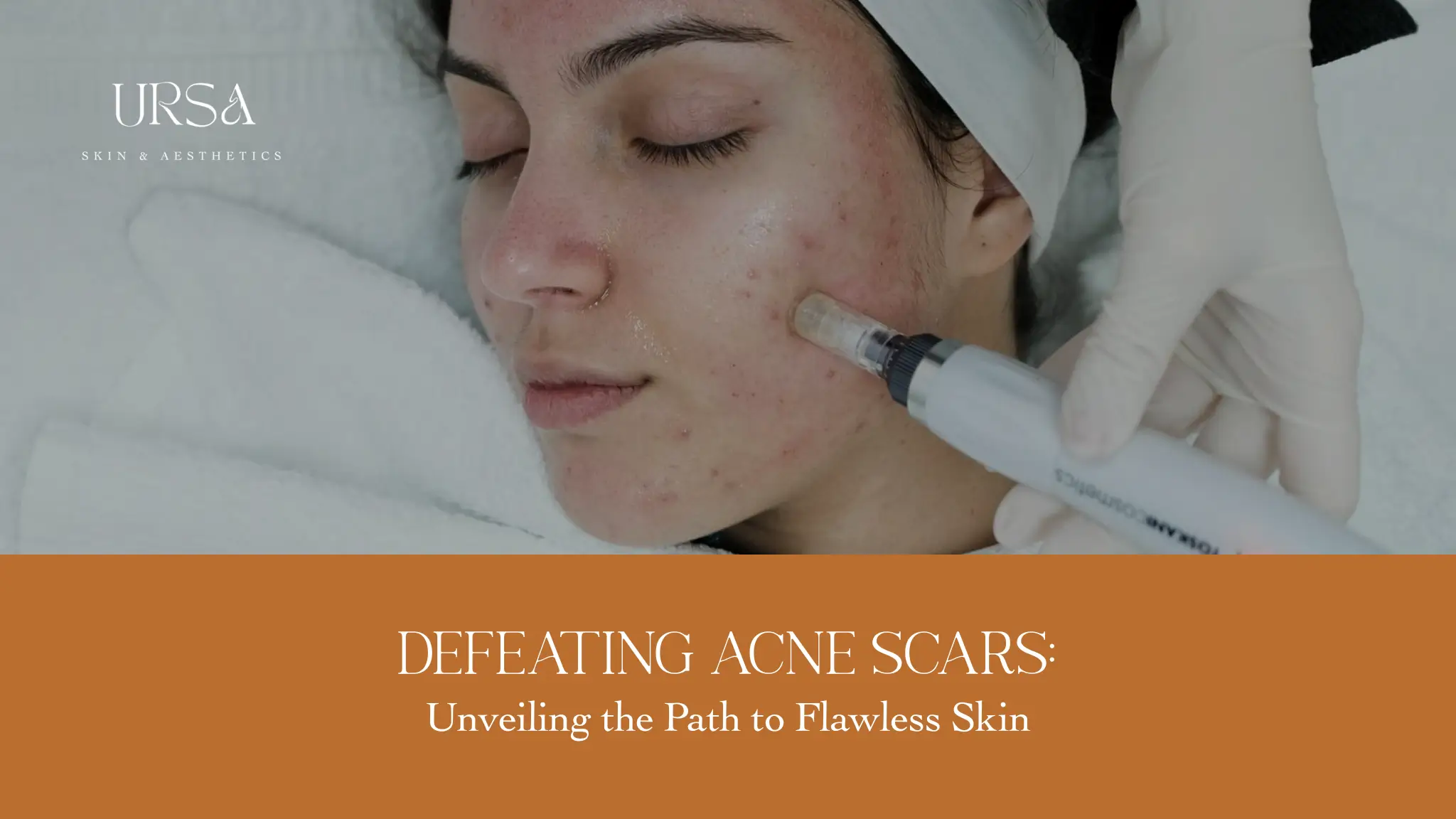
Microneedling is the cornerstone treatment for most atrophic acne scar types at Ursa Skin. It is safe for all skin types including the darker Indian skin tones where laser-based treatments carry higher pigmentation risks, and it produces consistent, progressive improvement with each session.
The mechanism of microneedling for scar improvement is based on controlled collagen induction. By creating thousands of micro-channels in and around scar tissue, microneedling triggers a wound-healing response that deposits new, healthy collagen in the scar zone. Over a course of 4 to 6 sessions, this progressive collagen deposition gradually elevates the base of atrophic scars, smoothing the skin surface and improving the texture and depth of rolling and boxcar scars significantly. Adding PRP to each microneedling session amplifies the growth factor stimulus, accelerating collagen production and producing superior results compared to needling alone. Our Dermapen 4 treatment uses the most advanced automated microneedling technology for optimal precision and safety. For patients wanting the most intensive collagen remodelling, we also offer Morpheus8 radiofrequency microneedling which combines deep needle penetration with radiofrequency energy for enhanced scar remodelling.
Start Your Acne Scar Journey at Ursa Skin
Book a comprehensive acne scar assessment with our expert dermatologists in Gurgaon or Delhi. We will map your scar types and design the most effective treatment programme for your skin.
5. Chemical Peels for Acne Scar Improvement
Chemical peels play an important role in the acne scar treatment toolkit, particularly for surface-level scar improvement, post-inflammatory pigmentation, and overall skin quality enhancement.
Salicylic Acid Peels for Active Acne Component
For patients who still have some active acne alongside their scarring, salicylic acid peels address both simultaneously. Salicylic acid penetrates into pores to dissolve sebum and reduce bacterial colonisation while simultaneously providing surface exfoliation that accelerates PIH resolution. Regular salicylic peels throughout the scar treatment programme keep the skin clear of new breakouts that would create new scars.
TCA Peels for Boxcar and Rolling Scars
Medium-depth trichloroacetic acid (TCA) peels penetrate into the upper dermis and stimulate significant collagen remodelling. For boxcar and superficial rolling scars, a series of medium TCA peels produces meaningful improvement in scar depth and overall skin texture. These are most effective when combined with microneedling sessions, with the two modalities alternated to maximise cumulative collagen stimulation.
TCA Cross for Ice Pick Scars
Ice pick scars are notoriously resistant to general resurfacing treatments due to their deep, narrow architecture. TCA Cross (Chemical Reconstruction of Skin Scars) involves the precise application of high-concentration TCA (80 to 100%) directly into individual ice pick scars using a fine applicator. This triggers a focal inflammatory healing response that fills the narrow scar channel from the base upward over subsequent weeks. TCA Cross is the most effective targeted treatment for ice pick scars and is a core part of the comprehensive scar protocol at Ursa Skin. Read our guide on radiant skin with chemical peel treatment for broader context on peel applications.
6. Laser Treatments for Acne Scars
Laser resurfacing is one of the most powerful modalities available for acne scar treatment, capable of producing significant improvement in a single session for appropriate candidates. The choice of laser technology is critical, particularly for patients with darker skin tones.
Pico Laser for PIH and Surface Scars
Pico laser treatment delivers ultra-short pulses of laser energy that create a photoacoustic rather than photothermal effect in the skin. This makes it safer for darker skin tones than traditional Q-switched lasers for pigmentation treatment. Pico laser also stimulates collagen remodelling through its tissue interaction, making it useful for both the pigmentary and textural components of acne scarring. For patients with significant PIH alongside structural scarring, starting with a Pico laser course to clear pigmentation before addressing structural scars with microneedling produces a cleaner canvas and better overall outcome.
Q-Switch Laser Toning for PIH
Q-switch laser toning uses low-fluence, high-frequency laser energy to gently break down melanin in the superficial dermis without ablating the skin surface. It is highly effective for diffuse PIH from acne and produces progressive lightening of post-acne dark marks with each session. Most patients notice significant improvement in their PIH within 4 to 6 sessions.
Carbon Laser Facial for Ongoing Maintenance
The carbon laser facial plays a supporting role in the acne scar programme by maintaining clear pores, controlling oiliness, and providing monthly collagen stimulation between more intensive treatment sessions. It is particularly valuable for patients whose scarring is accompanied by ongoing mild acne and pore congestion. Read our detailed guide on carbon laser facial for flawless skin.
7. The Combination Approach: Why It Works Best
The most consistently impressive acne scar outcomes at Ursa Skin are achieved with a well-designed combination approach that uses multiple treatment modalities in a thoughtful sequence to address different aspects of the scar pathology simultaneously.
A typical comprehensive acne scar programme at Ursa Skin might begin with sessions to control any active acne and clear existing PIH using salicylic acid peels and Q-switch laser toning. Once the skin is clear and the canvas is even, a core course of microneedling with PRP sessions forms the foundation of structural scar improvement. TCA Cross is performed on ice pick scars during the same period. Medium TCA peels are alternated with microneedling to maximise both surface and dermal collagen stimulation. Carbon laser facial sessions are incorporated monthly for ongoing oil control and maintenance brightening. The programme is reviewed after 6 months and adjusted based on the treatment response observed.
Research published in the Dermatology Times consistently shows that combination treatment protocols achieve 50 to 80 percent improvement in standardised acne scar scores compared to 20 to 40 percent improvement with single-modality approaches, strongly supporting the multi-treatment philosophy at Ursa Skin.
8. Controlling Active Acne First
Before beginning any acne scar treatment programme, active acne must be adequately controlled. This is a non-negotiable clinical principle: treating scars on skin that is still breaking out is counterproductive because new breakouts create new inflammatory events that can worsen existing scars and create new ones, undermining the results of every treatment session.
At Ursa Skin, patients presenting with both active acne and scarring are first assessed for the appropriate medical acne management strategy. This may include topical treatments containing retinoids, benzoyl peroxide, or azelaic acid, oral antibiotics where clinically indicated, and professional salon treatments such as regular HydraFacial or salicylic acid peels to keep pores clear. Once breakout frequency is significantly reduced, the scar treatment programme can begin on a clearer, more stable canvas that responds predictably to treatment.
Never pick or squeeze acne lesions. Manual extraction dramatically increases the depth of dermal damage and the likelihood of permanent scarring. If your acne requires extraction, have it performed professionally by a trained clinician using sterile technique.
9. Building Your Acne Scar Treatment Plan
Every acne scar treatment plan at Ursa Skin is built around the individual patient’s specific scar types, skin tone, lifestyle, and timeline. There is no one-size-fits-all protocol, and the quality of the initial assessment determines the quality of the treatment plan.
The Assessment
Your assessment at Ursa Skin includes a detailed examination of scar types and distribution, skin tone assessment using the Fitzpatrick scale to determine which modalities are safe, photography for progress documentation, and a thorough medical history review including current skincare products, previous treatments, medications, and any known skin sensitivities. This comprehensive baseline is what enables our clinicians to design a programme that is both effective and safe for your specific skin.
Managing Expectations
Honest expectation management is central to patient satisfaction in acne scar treatment. Significant improvement — often 60 to 80 percent reduction in scar visibility — is achievable with a well-executed combination programme. Complete elimination of all scarring is not a realistic goal for most patients, and clinics that promise otherwise are not being truthful. The focus at Ursa Skin is on maximising improvement while maintaining realistic, transparent communication with every patient throughout the programme.
Key Takeaways
- Acne scars are permanent structural skin changes requiring active treatment — they do not resolve on their own.
- Different scar types require different treatment modalities: microneedling for rolling and boxcar scars, TCA Cross for ice picks, laser for PIH.
- A combination approach using multiple modalities sequenced correctly produces superior results to any single treatment.
- Active acne must be controlled before beginning a scar treatment programme for effective and lasting outcomes.
- Significant improvement of 60 to 80 percent is a realistic and achievable goal with a well-designed programme at Ursa Skin.
- Early treatment of acne scars during the 20s and 30s produces the best outcomes as skin collagen density supports faster and more complete remodelling.
10. Ursa Skin Serves Patients Across Delhi NCR
Ursa Skin offers comprehensive, medically supervised acne scar treatment programmes at our Gurgaon and Delhi clinics. Our dermatology-trained team uses the full range of available treatment modalities to design and deliver the most effective, personalised scar improvement protocol for every patient.
11. Related Reading
12. Frequently Asked Questions
Can acne scars be completely removed?
Complete removal of acne scars is difficult to achieve and depends on the scar type and depth. However, significant improvement — often 60 to 80 percent reduction in scar visibility — is achievable with a well-planned combination treatment approach. Most patients achieve a skin quality they are satisfied with after a proper course of treatments at Ursa Skin.
What is the best treatment for acne scars?
There is no single best treatment for all acne scars because different scar types respond to different modalities. A combination approach is consistently superior to any single treatment. For most patients, microneedling combined with PRP and chemical peels forms the foundation of an effective acne scar treatment protocol, with laser treatments added for more resistant cases.
How long does it take to see improvement in acne scars?
Visible improvement in acne scars typically begins to appear after 2 to 3 sessions of treatment and becomes increasingly significant as the course progresses. The full benefit of a complete treatment course, including collagen remodelling that continues for months after each session, is typically visible 6 to 12 months after beginning a structured programme.
Is microneedling or laser better for acne scars?
Both microneedling and laser resurfacing are effective for acne scars and are often used together for best results. Microneedling is safer for darker skin tones and delivers consistent progressive improvement with minimal downtime. Laser resurfacing can produce more dramatic improvement in fewer sessions but involves more recovery time and carries higher pigmentation risk in darker skin. A combination of both is often the most effective approach.
How many sessions are needed to treat acne scars?
Most patients with moderate acne scarring require a minimum of 4 to 6 sessions of their primary treatment, spaced 4 to 6 weeks apart, to achieve significant improvement. More severe scarring may require 8 or more sessions across different modalities over a longer period. The number of sessions needed is determined by the scar type, depth, and the patient’s individual healing response.
What is the difference between acne marks and acne scars?
Acne marks (post-inflammatory hyperpigmentation) are flat discolorations left after an acne lesion heals. They are not true scars and fade on their own over months with proper sun protection, though treatments can accelerate this. True acne scars involve a change in the physical texture or architecture of the skin — depressed areas, pits, or raised fibrous tissue — and require more intensive treatment.
Can acne scars worsen over time?
Depressed atrophic acne scars do not typically worsen over time, but they become more visually apparent as the surrounding skin loses collagen and volume with ageing. This is why treating acne scars while the skin still has good collagen density, typically in the 20s and 30s, produces better outcomes than delaying treatment to later decades.
Should I treat active acne before addressing acne scars?
Yes. Active acne should be controlled before beginning an acne scar treatment programme. Treating scars on skin that is still breaking out is counterproductive because new breakouts will continue to create new scars. Your clinician at Ursa Skin will assess your acne activity and may recommend an acne control protocol before beginning scar treatment.