
KEY HIGHLIGHTS
- Pico and Q-Switch lasers both treat pigmentation, but differ in pulse speed and how they break down pigment.
- Pico laser is often used for pigmentation that hasn’t responded to other treatments, including Q-Switch.
- Neither is universally ‘stronger’ — the right choice depends on your pigmentation type and treatment history.
Pico laser and Q-Switch laser are frequently mentioned in the same breath for pigmentation treatment, and it’s reasonable to wonder what actually separates them. The core difference comes down to pulse speed and how each technology breaks down pigment in the skin.
How Q-Switch Laser Works
Q-Switch technology delivers energy in nanosecond pulses, heating and shattering pigment particles in the skin, which the body then gradually clears. It’s a well-established, widely-used technology for sun spots, pigmented lesions, and general laser toning.
How Pico Laser Works
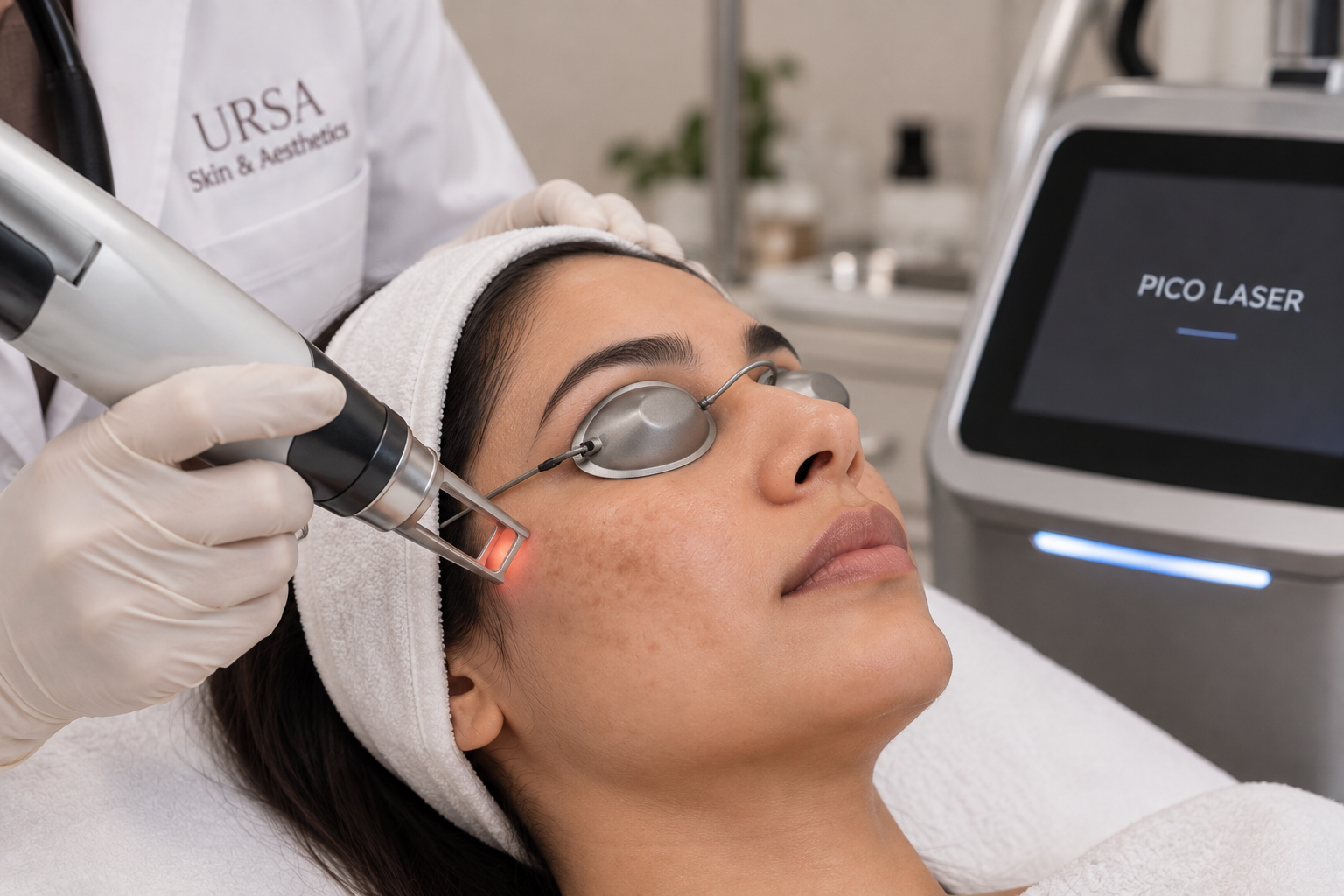
Pico laser delivers energy in picosecond pulses — significantly faster than nanosecond pulses — which shatters pigment into much smaller particles through a more mechanical process, generating less heat in the surrounding skin. This tends to make it effective for pigmentation that’s proven more resistant to other treatments, while also being comparatively gentler on the surrounding tissue.
Pico Laser vs Q-Switch Laser — Side by Side
| Q-Switch Laser | Pico Laser | |
| Pulse speed | Nanosecond | Picosecond (faster) |
| How it breaks down pigment | Heat-based shattering | Mechanical, less heat generated |
| Best suited for | Sun spots, general pigmented lesions | Stubborn or resistant pigmentation |
| Skin impact | Effective, well-established | Comparatively gentler on surrounding skin |
Which One Should You Choose?
For straightforward sun spots or general pigmentation, Q-Switch laser is often the first-line recommendation — it’s effective and well-studied. For pigmentation that hasn’t responded well to Q-Switch or other treatments, Pico laser is frequently the next step, particularly for more resistant or deeper pigment.
How URSA Decides
This decision is made based on your pigmentation type, depth, and treatment history — not a default assumption that one technology is simply better than the other across the board. [Link to: Pico Laser page] [Link to: Q-Switch Laser page]
The Bigger Point
Both are genuine, effective technologies when used appropriately — the real risk isn’t choosing the wrong one between these two, it’s ending up at a clinic using underpowered or non-genuine versions of either. [Link to: Pigmentation Treatment page]
If you’ve tried one laser type without the results you expected, that’s not necessarily a dead end — it may simply mean the other technology, or a combination approach, is worth discussing with a dermatologist.